

Tuğrul Tamtürk, General Manager of Enfotek A.Ş., answered our questions in the second part of the "Unfinished ERP Projects and Their Costs to Businesses".
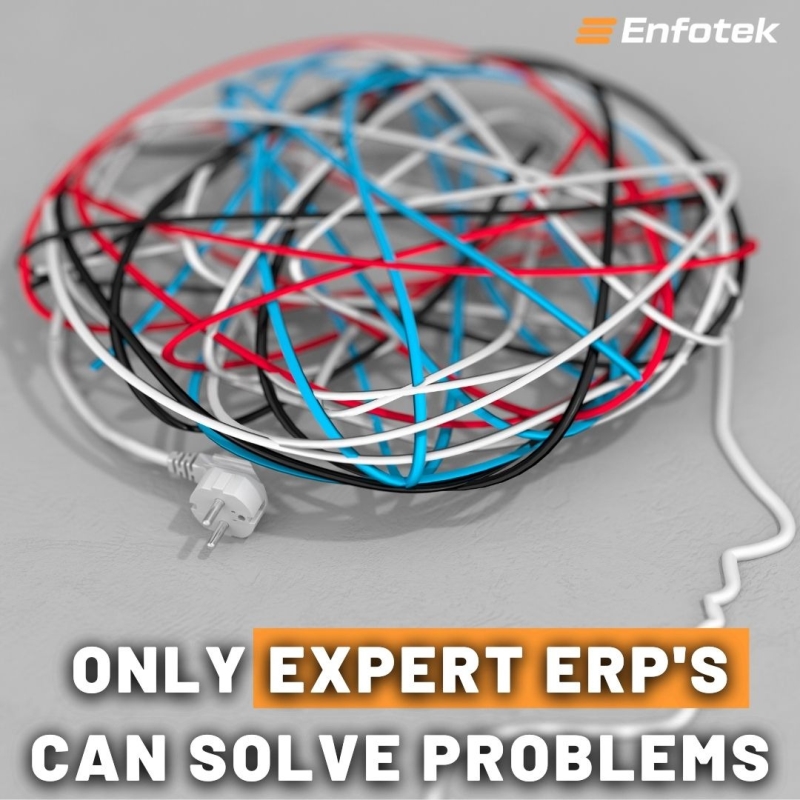
Tuğrul Tamtürk, General Manager of Enfotek A.Ş., answered our questions in the second part of the "Unfinished ERP Projects and Their Costs to Businesses". Explaining why ERP projects in businesses were left unfinished in the first interview, Tamtürk said that it was not easy to call the ERP project 'successful'.
"Determining whether an ERP project is successful or not is not an easy task," said Tamtürk, adding, "In a study conducted even in America, one of the countries with advanced digital culture, the rate of those who think that ERP projects in which billions of dollars are invested provide benefits for companies is around 28-30 percent. On the other hand, there are projects where 70 percent of the employees report an ambiguous or negative response. In a country like Turkey with a working culture and business management, I think 1 or 2 percent positive feedback will be enough to call us a 'successful project'. Tamtürk answered our questions as follows.
Why is the issue of ERP project such an enigmatic subject? Is it because it's so versatile?
Tuğrul Tamtürk: Yes. This is because people embrace a system that is right or wrong. After a while, operational blindness develops against the faults of the system. The systems must be audited by experts from the outside, objectively. Even though the management makes the final decision, the management should not be included in the audit processes. Because it is difficult for major problems to emerge with internal audit.
What causes users to want to run a new project?
TT: Employees and managers, who see the negative results of a software called ERP, lose their faith in this ideal as years go by. They consider the management with Excel, e-mail, which we call semi-manual, less risky. They think that everything can change at any moment. They prefer systems where they don't have to decide. They may have an understanding that has no future. When hundreds of personnel who have experienced these unsuccessful experiences change jobs and go to the new company, it becomes more difficult to convince them of the system there.
Any drug is toxic when used in the wrong dose. Doctors know that this is revealed by certain scientific studies. Doctor is the expert. The tendency to view software as a stand-alone magic wand is erroneous. Software is a tool like medicine. And it is essential to make adaptation studies related to re-adapting each software to the organization and characteristics of each business. It is a mistake to think that 'software like a pill' will work in the field we call corporate software without doing this. Making comments such as 'plain, nice screen, simple color' to the software without analyzing its needs is due to the fact that the managements do not know which processes to manage from the ERP. Firms that don't know their real needs fall victim to software marketers.
Although there are 'Expert ERPs' specific to some sectors, there are no software systems operating in this field for some sectors. How do companies in that sector choose the right ERP?
TT: There is a big gap in the market in this regard. First of all, companies should look at how many years the company they will work with has been operating. Experience is important in this regard. Again, managers first look at the price of ERP software. The effect of the ERP system they will choose on the profitability of the company, how it will contribute to the business processes and how it will apply simplicity to the production processes are ignored.
So how do we know that a software is an expert?
TT: The software company should include experts from general engineering fields. Must have 10 years or more of consulting experience in the field. They should include engineers MSC who have been managers among them. Because the client does not do modelling. He/she can transfer its own processes. The client does not have a clear map of the workflow. Creating it is also a service that expert ERPs can provide. Observation and on-site determinations and analyzes are required. Those experienced consultants and engineers come into play here.
The flow the customer says is the result. It is not the reason. For example, it is the result that quality control determination cannot be made. Maybe this is due to an information error that occurred when the first order was received. A small mistake can grow like a snowball during the workflow. And it causes the obvious problem in one step. The problem will not be solved if you dress up by looking at the incident only as a departmental problem. The problem must be looked at across the business. An Expert who understands cause and effect relationships and understands the workflow of that business can solve the ERP problem.
Back to all articles