

Turkey can win in AI not by building chips, but by smartly integrating AI into its industries.
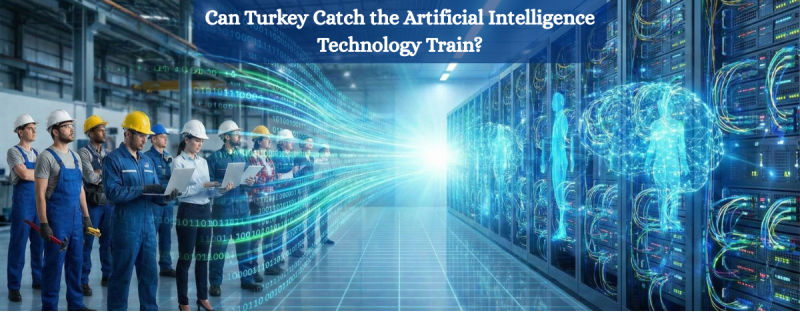
The world is experiencing one of the greatest technological breaking points seen since the industrial revolution. Artificial Intelligence (AI) has ceased to be merely a software trend and has transformed into a strategic power determining the destiny of nations. So, where does Turkey, boasting of its young population and dynamic workforce, stand on this train?
Although Turkey is one of the luckiest countries in Europe in terms of young and intelligent human resource potential, it is not yet at the desired level in creating competitive technological products that "touch real life" in the field of technology. While Technoparks and R&D centers are in a major breakthrough numerically (with over 100 Technology Development Zones and more than 11,000 companies across Turkey), serious bottlenecks are experienced in transforming quantity into quality
The Bitter Truth in Numbers: Remaining a "Dwarf" in R&D Investments
The most critical fuel for technology companies to survive and innovate is R&D investments. However, Turkey's scorecard in this field reveals a thought-provoking picture when compared with global competitors.
According to TÜİK (Turkish Statistical Institute) and OECD data, the share Turkey allocates to R&D from its Gross Domestic Product (GDP) hovers around 1.32% to 1.40%. This rate is an indication that we are trying to manage with our own limited resources. However, when we look at the countries that are "playmakers" in the global technology arena, we see how wide the gap is:
● Israel: 5.6%
● South Korea: 4.9%
● USA: 3.5%
● OECD Average: 2.7%
These figures show that Turkey remains a "dwarf" in terms of investment power compared to global giants. In a "miraculous" technology like artificial intelligence, which has attracted hundreds of billions of dollars in investment in the last 3 years, competing with these budgets may seem impossible. So, how will Turkey apply this technology to its industry with its own means?
The Open Source Revolution and the February 2025 Breakpoint
Developing artificial intelligence, especially training a "Foundation Model" from scratch, requires massive capital. Even setting up the most modest AI server cluster requires millions of dollars in hardware investment (NVIDIA H100/Blackwell GPU costs, etc.), which far exceeds the capacity of the Turkish startup ecosystem.
At this very point, a development in February 2025 opened a window of opportunity that shook global balances: The introduction of the Chinese-origin DeepSeek model and its release as open-source.
With this strategic move, China made AI "collective," preventing American tech giants (Google, OpenAI, Microsoft) from monopolizing the market. DeepSeek's success proved that you don't have to train models with trillions of parameters; instead, you can take these models and customize them (fine-tuning) with your own data. This situation created a vital chance for countries struggling with hardware investment, like Turkey. The issue has now shifted from "who trained the model" to "who integrates the model into business processes best."
Infant AI and the "Engineering" Gap
At the point we have reached today, there is a fundamental reason why Artificial Intelligence investments have not yet fully translated into real business processes and profitability: The gap between AI and real business workflows/engineering discipline.
We can currently think of AI as a "baby with incredible potential, very intelligent but not knowing what to do." There is a need for "adults" to hold this baby's hand, show it around the factory, teach it the textile loom, and explain the intricacies of the supply chain. Only sector experts (Domain Experts) and engineers can fill this gap
Although Turkey cannot develop silicon chips, it possesses a very strong industrial infrastructure ranging from textiles to automotive, metals to plastics, and expert staff trained in these fields. Turkey's real opportunity lies in blending this deep "Domain Knowledge" with next-generation AI technologies.
A Domestic Success Story: ENFOTEK and Enterprise AI
One of the most striking examples where this theoretical opportunity is put into practice comes from ENFOTEK, a company that has been operating in the industrial software field (PLM-PDM-ERP) for many years.
ENFOTEK, which has quietly but profoundly realized a revolution in adapting AI to businesses recently, completed laboratory tests and determined how the AI model should be shaped according to business needs. Going beyond using ready-made APIs, it has developed a software technology entirely of its own on all AI application methods.
According to the latest information obtained, the system developed by ENFOTEK has the following critical capabilities:
1. High-Efficiency RAG (Retrieval-Augmented Generation): It connects securely to the enterprise's GBs of corporate data (ERP, PLM databases), analyzing the data without leaking it externally.
2. Executive Assistant: It answers complex questions from business owners and managers (e.g., "What is the correlation between our cost increase and order cancellations compared to the same period last year?") in seconds.
3. Autonomous Decision Support System: It not only reports but, being trained with Business Rules, proactively guides employees with warnings like "If you accept this order at this price, you will make a loss."
Conclusion: The Train Hasn't Left Yet
For Turkey to exist in the artificial intelligence race, it does not have to be a hardware manufacturer; but it must be an "implementer." As in the ENFOTEK example, domestic companies that combine industrial experience with AI's processing power will play a key role in overcoming economic bottlenecks.
Our industry's data is too valuable to be entrusted to closed-box artificial intelligence models outside. Therefore, supporting systems that can work safely with domestic and national enterprise artificial intelligence models can ensure that Turkey catches this technology train not just as a "passenger," but as a "machinist."
The future will belong not to those who code AI, but to those who best integrate it into their business. We eagerly await new success stories.
References and Data Notes
● TÜİK R&D Data: Turkish Statistical Institute, "Research and Development Activities Survey, 2023" (Publication Date: November 2024) and 2024 preliminary data.
● Global R&D Comparisons: OECD (Organisation for Economic Co-operation and Development), "Main Science and Technology Indicators", Volume 2024/2 and 2025 projections (Israel, S. Korea, and USA GDP shares).
● Technopark Statistics: Republic of Turkey Ministry of Industry and Technology, "Technology Development Zones Statistics", current company and zone numbers as of December 2024.
● DeepSeek and Open Source AI: DeepSeek Official Blog & Press Release, "DeepSeek-R1 Open Source Release Notes", January-February 2025; WeForum - Open Source AI Innovation, 2025.
● Enterprise Application Example: ENFOTEK Inc. corporate website, product development bulletins, and sectoral technology news (2025).
Back to all articles