

Enfotek A.Ş. continues its cooperation with universities for the professional use and dissemination of ERP (Enterprise Resource Planning) Solutions and Applications.
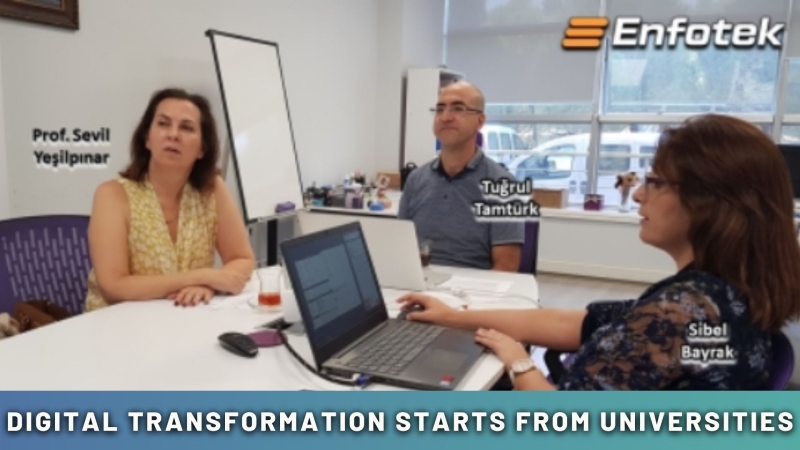
Enfotek A.Ş. continues its cooperation with universities for the professional use and dissemination of ERP (Enterprise Resource Planning) Solutions and Applications. In this direction, Enfotek, which made its first studies with Pamukkale University (PAU) and Ege University, finally agreed with Dokuz Eylul University. As a result of the meetings, a series of courses will be given to the final year students of Dokuz Eylul University Faculty of Textile Engineering, just like in PAU and Aegean. Regarding the content of the courses, Lecturer Prof. Sevil Yeşilpınar at Dokuz Eylul University (DEU) Textile Engineering Department Apparel Department, Enfotek General Manager Tuğrul Tamtürk, Enfotek Training Unit Leader Sibel Bayrak held a meeting. At the meeting, ideas were exchanged on the content of the ERP training to be given at the university. At the end of the meeting Prof. Sevil Yeşilpınar answered Enfotek's questions. Yeşilpınar said: “Digital transformation starts with universities”.
Could you briefly introduce yourself?
Hello, my name is Sevil Yeşilpınar. I am a faculty member at Dokuz Eylul University (DEU) Textile Engineering Department, Apparel Department.
How is the education going at the university now? What are you aiming for as a department? Can we get a general information?
Our department includes a 5-year education. There is an English preparatory class in the first year. Because our industry is export-oriented and we care about our graduates speaking 1 foreign language. Courses such as mathematics, physics and chemistry are taken in the first year, and engineering and vocational courses begin in the second year. We have a curriculum in which basic textile information is given in the first 3 years of our education, and in the last year, our students can develop themselves in whatever field they are interested in. 40 students come to our department every year. The physical conditions, especially in terms of infrastructure, classrooms and workshops, are quite good in our faculties. There are many materials that we have obtained with the Ministry of Industry, State Planning Organization Projects and TÜBİTAK and DEU's own means. We attach importance to application as well as technical knowledge. Course information is supported by experiments in the laboratory, 3 internships are compulsory during the summer semesters. The first internship is in the form of workshop training. It is a university-vocational high school partnership. The 2nd year internship is an integrated internship. Here is an internship where we aim to see all stages of textile production in integrated facilities for a period of 6 weeks. In the 3rd year, we apply an internship in which our students are interested in the field they are interested in. In the last year, besides technical information, we also have social course selections. Because they will take part in joint projects with more than one person in business life, we also attach importance to social development. We have Erasmus agreements with 11 universities from Europe. We also have double major and minor opportunities in our department. Our laboratories are also accredited. We have accredited our laboratories 2 times for 5 years (education-laboratory accreditation)…
You were also Head of the Department. Can you share your experience about this? What kinds of problems did you experience?
Our department has 20 years of history. We had infrastructural shortcomings in the past. But we had to make up for our shortcomings in a short time since it was built on textile application. We were physically deficient. However, when our department moved to Tınaztepe Campus, the conditions improved. I can say that the only problem we have at the moment is the shortage of technical personnel. Even though we get support from the dean's office when our laboratory equipment breaks down, state universities have limited opportunities. In such cases, we sometimes have difficulties as maintenance-repair costs are high. We are trying to overcome the technical staff shortage with a good cooperation with the industry. As the support of the industrial sector, we get support such as software programs for free. We also have advisory groups that we have created in partnership with the industry. We can learn about the status of our graduates from these groups in their working life and internships. We also carry out interdisciplinary studies in partnership with companies in graduation projects.
As for your cooperation with Enfotek… This year, your department is launching an education campaign with Enfotek.
Our cooperation with Enfotek company dates back to 10 years ago. Tuğrul Tamtürk has always helped us because he is our former graduate… We are starting a process that will be beneficial for our students by adding EDS to our curriculum as an elective course this year. They will be able to learn a paid education out, for free, as a basic education at the faculty. After receiving this training, we will do our best to help them learn EDS at an advanced level with the support of seminars… Here, our academicians also have important duties. Today, the world is in the Industry 4.0 stage. In order for Turkey to reach this level, it is necessary to use fully integrated systems that are obvious to software. It is our duty to train the personnel who will use these systems. If we train well-equipped students, we are trying to train students integrated into the programs, whether it is computer programming, weaving-knitting-clothing design for our students in the first years. Since the young people of this generation are intertwined with computers from a young age, it is easy for them to adapt to these systems. It will be easier for them to take precautions by seeing the cost-time loss they will experience if their companies do not have such programs, systems and ERPs in their working lives tomorrow. If we cannot train engineers in this direction, we will miss the industrial movement. We are updating our education system with this perspective. We can say that digital transformation starts from universities…
What would you say about the development of EDS?
My thoughts are very positive. We know the importance of such ERP programs. When I complete the education together with the students in the faculty, I can make more comprehensive and accurate comments.
Back to all news