Altan Yalaz, the founder of Yalaz Tekstil, one of the first names that come to mind when it comes to Ready-to-Wear in Izmir, answered Enfotek's questions.
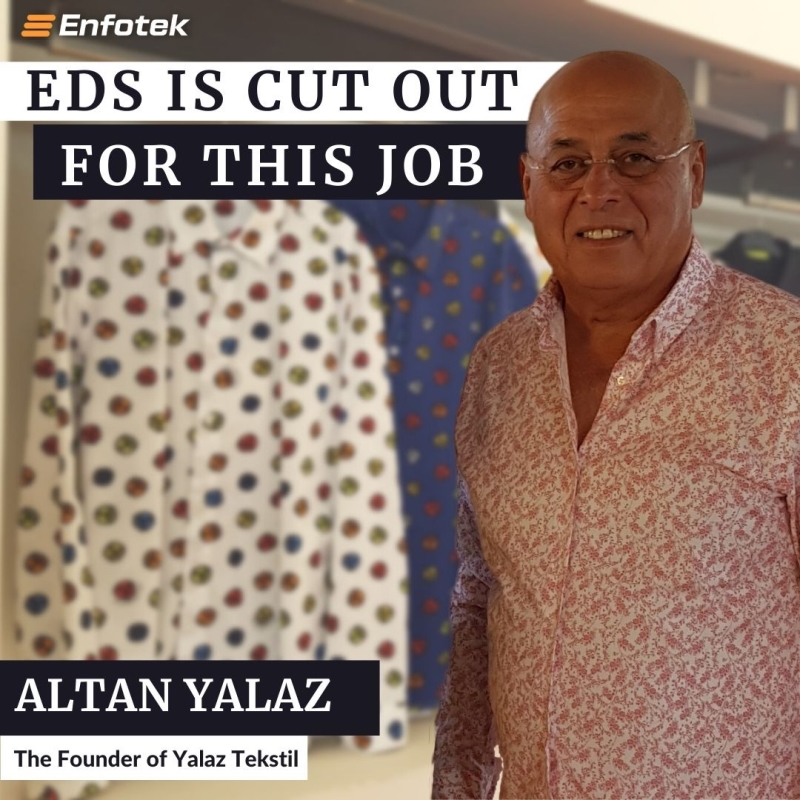
Altan Yalaz, the founder of Yalaz Tekstil, one of the first names that come to mind when it comes to Ready-to-Wear in Izmir, answered Enfotek's questions. Yalaz said: "EDS is cut out for this job," and added: "Everyone provides data flow securely using a single system, and can concentrate on their work without dealing with protecting and arranging data. Data security and ease of data entry and distribution are among its greatest contributions.” The answers of the Doyen Ready-to-Wear Expert are as follows:
Hello Mr. Altan, The Ready-to-Wear industry knows you well, but can we briefly get to know about you from your mouth?
Hello, I'm Altan Yalaz. I graduated from Ege University Textile Engineering Department in 1973. I worked for a German company for many years. I was the project manager there. I worked in countries such as Tunisia, Switzerland and Hong Kong, especially in Germany.
When was Yalaz Tekstil founded?
We established Yalaz Tekstil in 1990. After 4 years, we registered our FILO D'ORO brand and thanks to our 11 boutiques in the Aegean Region, we marketed half of our production with our FILO D'ORO brand, 40% of our production in the domestic market and 10% in exports.
So, how old is your background with EDS?
I will start as follows; In Hong Kong, I experienced very interesting things for that period. There, all the data of the day were sent to the center with small passwords. The boss used to visit every 6 months. The general manager wouldn't have come to company, either. The data was instantly followed up by everyone. That's what EDS does. EDS is perfect for you to see this data. We used to do this manually before. Then, Excel spreadsheets came out and each company started to produce and process their own data. However, they had some problems or missing parts. You could not see the previous data and analyze the data in the change you made through the Excel file. At this point, EDS helped us a lot, even though there were elbow rubbings at the beginning. It took about 8-10 months to get used to use EDS. We got used to it and then it became indispensable. There are companies realizing that they are sinking after they have sunk in the garment. That’s why cost accounting is very important. In this regard, EDS is one of the biggest tools.
What are the contributions of EDS to your business processes?
When you connect to the system from outside, you can see which order is in what condition. Moreover, the customer can connect to the system with a special password and see for himself what stage the product is at. Since we are close to Europe compared to Far East countries, we strengthen our hand with such programs. Everyone can safely stream data using a single system and can concentrate on their work without dealing with protecting and organizing data. Data security, ease of entry and distribution of data are some of its greatest contributions.
What would you say about Enfotek's consultancy services?
We haven't seen each other very often for a while. However, we will hold a meeting soon to discuss the situation and current issues. But I know we didn't have any problems. When I talk to friends, I see that they are all satisfied.
Mr. Altan, how would you interpret the developments in the sector based on your many years of experience? Can we get your thoughts on the position and future of the sector in the national and international market?
I often keep in touch with the university I graduated from. I am the Chairman of the Board of Ege University Textile Engineering Graduate Association. I am in contact with academicians and students. I hold conferences and talks. They even gave my name by modernizing a classroom in our department, thank you. Of course, most people have a negative view of the apparel industry. Between 1985 and 1995, apparel and textile exports constituted 40 percent of Turkey's exports. In those years, exports increased by 30 percent. The momentum was always up. There are no old increases today. It’s between 5-10 percent. That's why it looks negative. But it's not because the garment is in poor condition. Other sectors have developed. Due to reasons such as the Far East being a new market and the development of the machinery sector, it seems that the total export volume of textile has decreased to 20 percent. Clothing did not go back. Turkey plays in the Champions League of this business. Today, Turkey does boutique-like, more value-added, short-term works. Large quantity orders are taken. There are friends who have facilities in the Balkans. To know the marketing of this business, it is necessary to know the production well. Turkey is very successful at this point. Good product means good quality. 25 years ago, when you were working at 60 percent efficiency, you were making 30 percent money. But today, when you work with 60 percent efficiency, you will go bankrupt, when you work with 70 percent efficiency, it is almost head to head. If you want to earn Money, you need to work efficiently for 80 percent. The competition is greater than it used to be. The customer does not cover the cost of your poor performance. Because there are so many alternatives now. I don't think this industry will die. Textile will see even better days in the future. In the global trade war, Turkey also entered the yarn and fabric nowknow from the time of Atatürk in apparel. There has been a lot of improvement in accessories. I am not hopeless.
What should be the strategy of the future in the sector?
Providing unlimited service to the customer, always improving yourself, your team, your company. Working peacefully with your team for many years.
In your opinion, what are the pleasant and difficult aspects of this industry?
Pleasant aspects: Doing business in the same lane with foreigners, and travelling very often. The constant use of a foreign language without being forgotten. The fact that people do not have the opportunity to be sick due to fast and movement. A healthy life. You never get bored. I don't think there is a difficult side.
As a Textile Engineer, why should students who will take the exam this year and whose engineering preference outweighs this department? What advice would you give to young people?
My biggest advice to young people is that they should keep their job while they are studying, they should work. Otherwise, they cannot establish a context between theory and practice when they enter business life. They should prioritize learning a foreign language. This industry is very active. And because we are competitive around the world, we generally work on exports. It is easy to learn a foreign language. They can also choose this department because it has advantages such as getting to know different countries and doing business, accelerating our self-development.